
Every field, both eyes
Vision, refraction, IOP, pupils and motility, then the anterior and posterior segment, with glaucoma, retina and squint panels that open when you need them.
The workup, the findings, the spectacle prescription and the photographs, for both eyes, on one patient record.
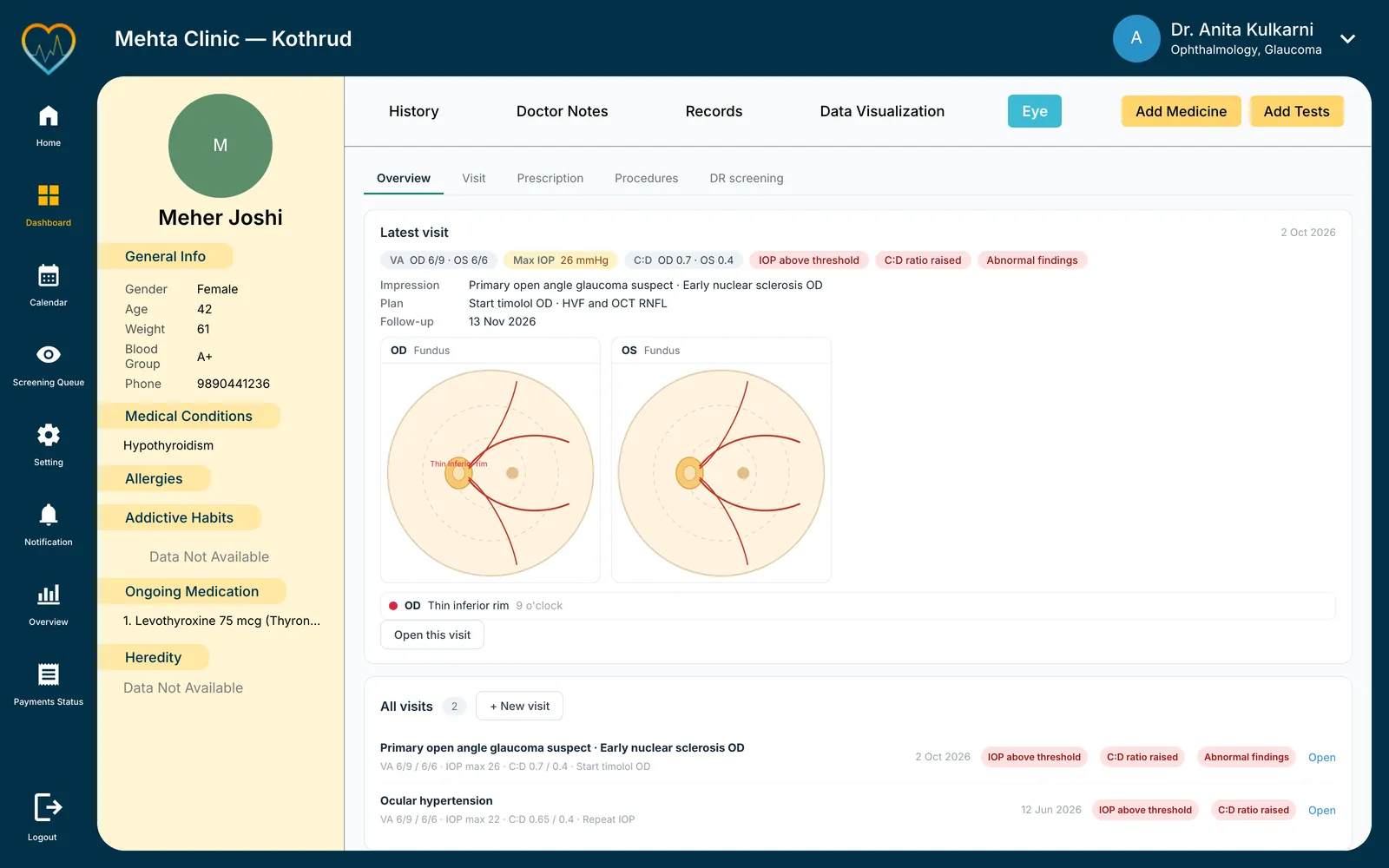
An eye visit is a two-person job. Your optometrist records the workup: vision, refraction, IOP, pupils and motility. You write the findings, the impression, the plan and the prescription.
Cohezo Health keeps both halves on the same visit, for the right and the left eye, so the record you open is already filled in.
The eye module sits inside the clinic software, so appointments, billing, certificates and WhatsApp work the same way they do for every other doctor.
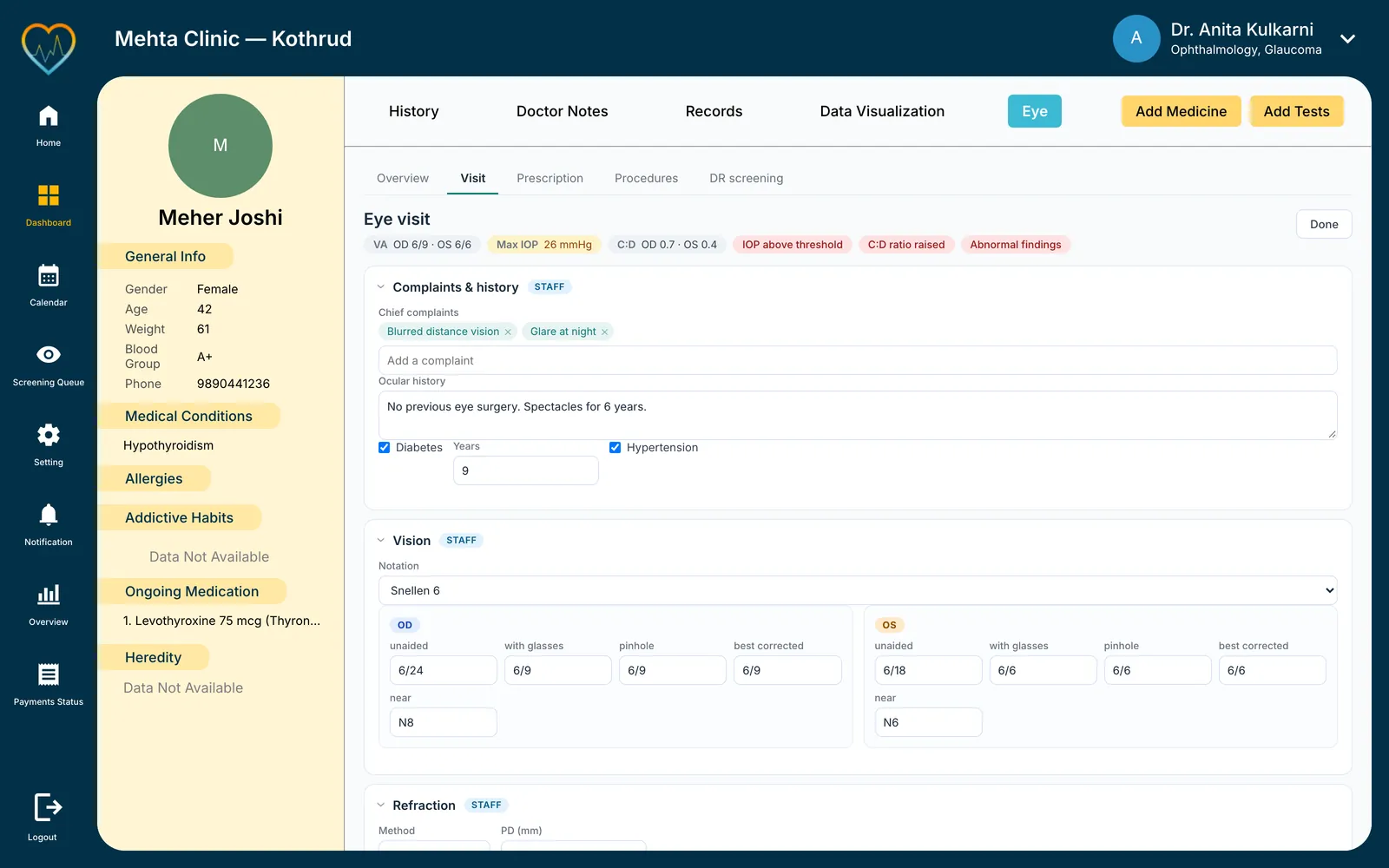
Vision, refraction, IOP, pupils and motility, then the anterior and posterior segment, with glaucoma, retina and squint panels that open when you need them.

An IOP over 21 mmHg or a cup-to-disc ratio of 0.6 or more is flagged on the visit, so a reading that needs a second look is never buried.

The glasses prescription prints on your letterhead or goes straight to the patient's WhatsApp.
The optometrist and the ophthalmologist work on the same visit, each in their own half, so nothing is copied over from a paper card.
Staff can record the workup but never the clinical findings: only an ophthalmologist writes the impression, the plan and the prescription.
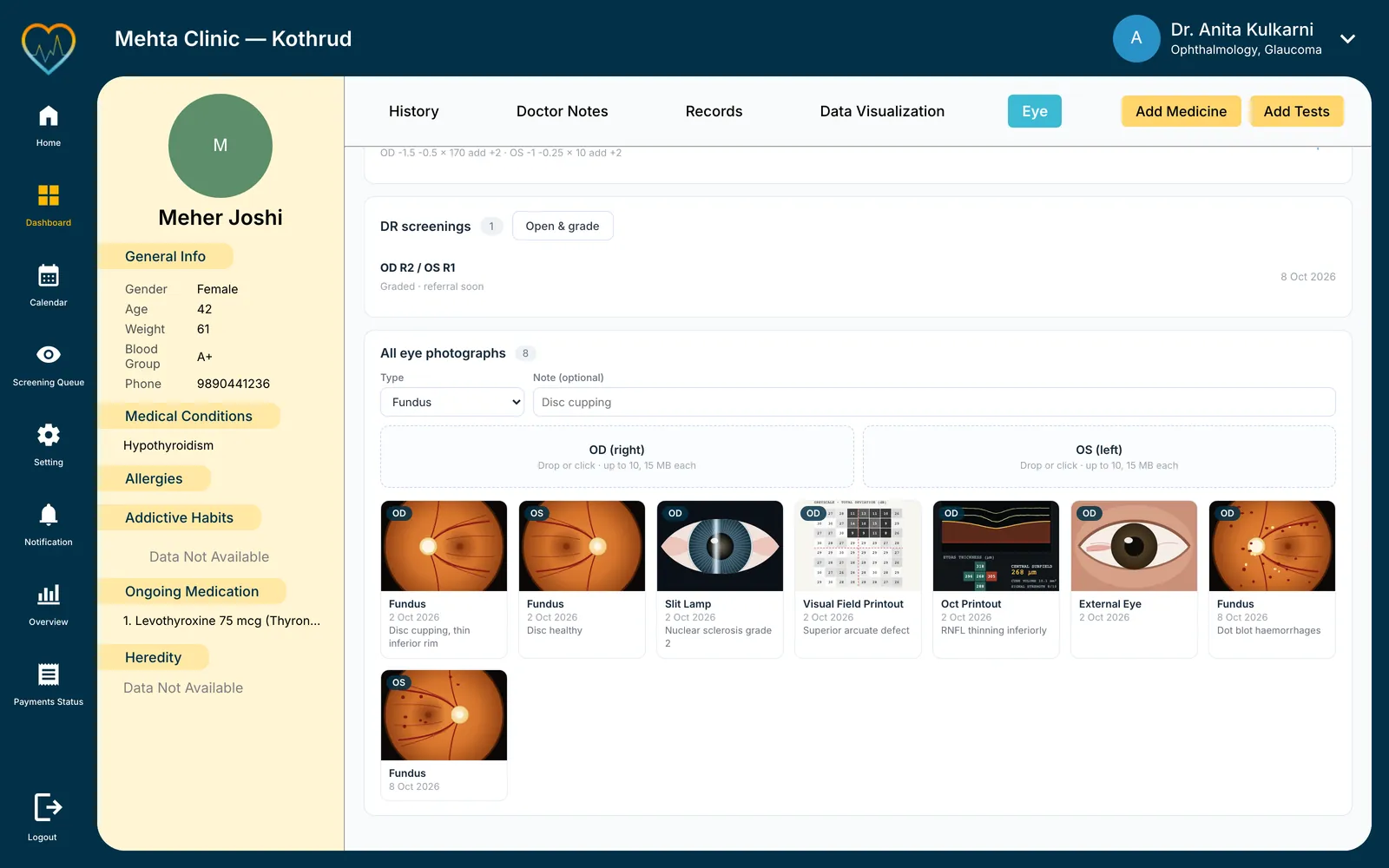
Fundus, slit-lamp, anterior segment and external eye photos, and OCT and visual-field printouts, go into a box for each eye and are filed against the visit that ordered them.
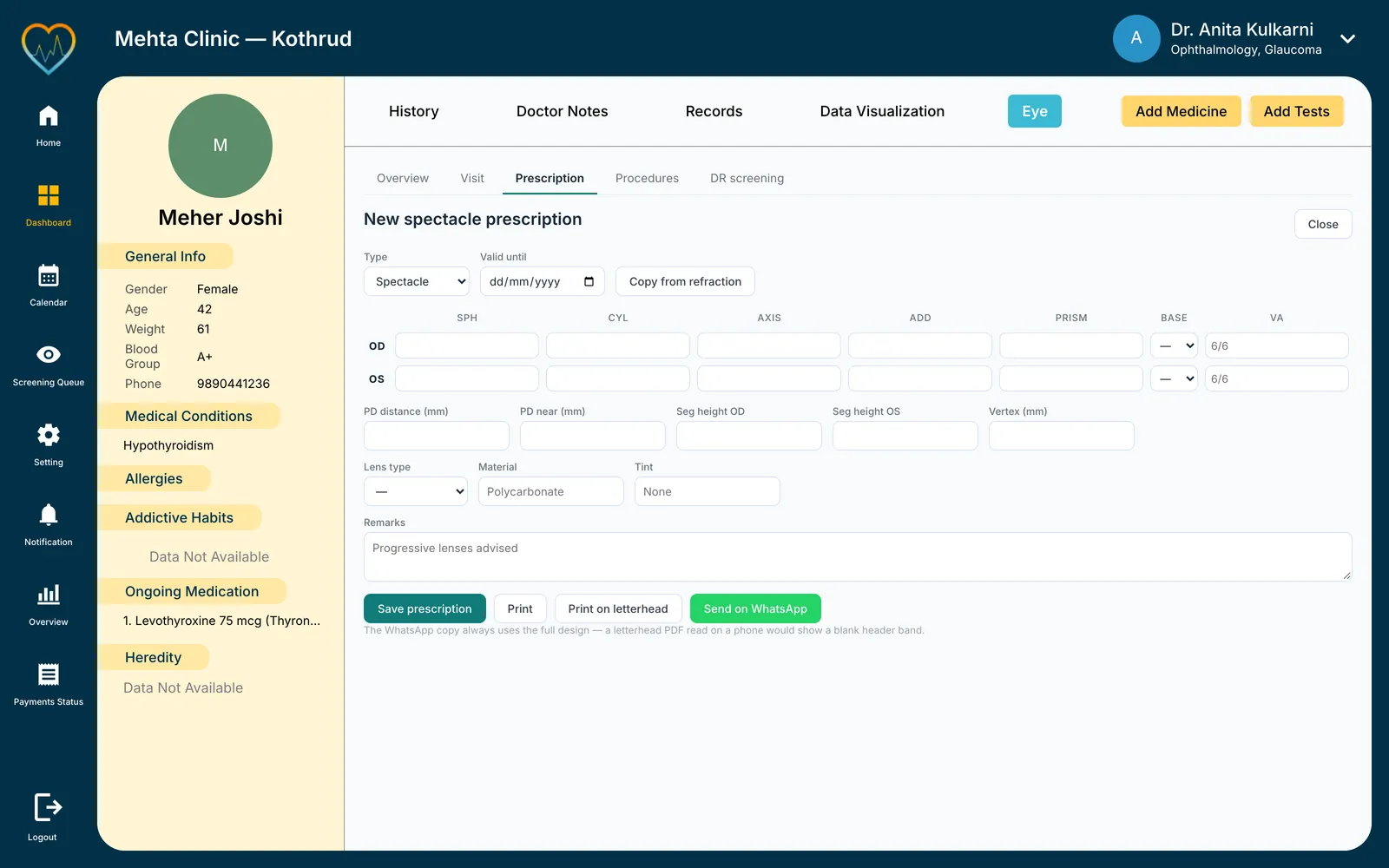
Sphere, cylinder, axis, add and prism for each eye, with pupillary distance, lens type and remarks. Print it on your letterhead or send it to the patient on WhatsApp.
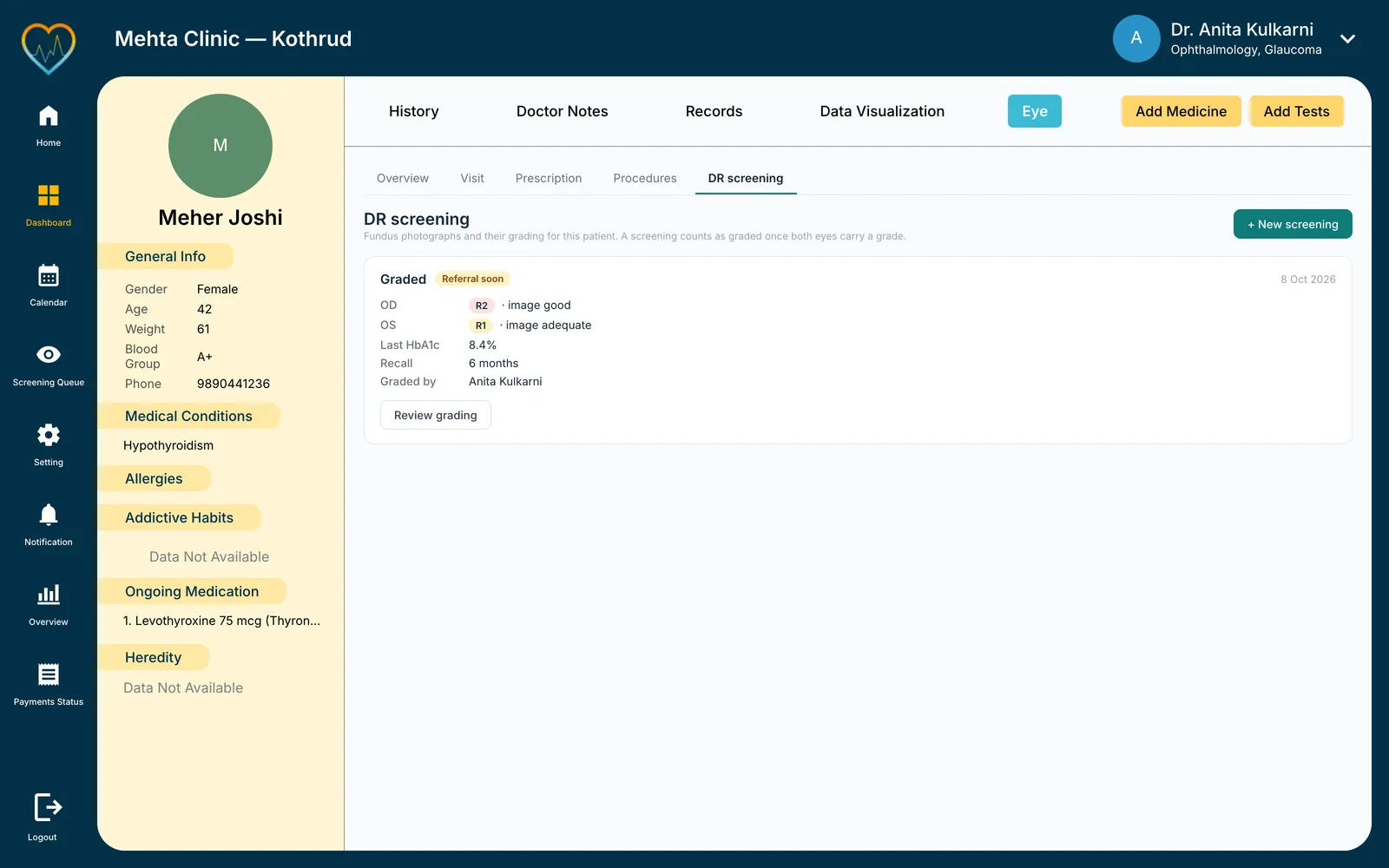
Grade each eye from its fundus photo, with image quality and maculopathy noted. A screening counts as graded once both eyes carry a grade, and a referable grade (R2, R3 or M1) raises the referral itself.
Screens from the demo clinic. The patient names and photographs are not real.
Your optometrist records the readings and photographs. Only an ophthalmologist can write the findings, impression, plan, prescription and procedures.
IOP, visual acuity and cup-to-disc ratio are tracked visit after visit, so a slow change is seen rather than remembered.
Mark findings on a schematic eye and a fundus chart. Every mark keeps its position and label, so it stays searchable instead of living only in a sketch.
Cataract, refractive, glaucoma, retina, laser, intravitreal injections, squint and oculoplasty procedures, recorded against the patient beside their visits.
Eye visits, prescriptions and procedures sit on the same timeline as the patient's other records, and feed the AI summary written before they sit down.
Appointments, billing with GST, certificates and WhatsApp reminders work exactly as they do for every other doctor in the clinic.
Each person signs in as themselves, so every reading and every finding carries who recorded it and when.
| Capability | Optometrist / staff | Ophthalmologist | Other doctors |
|---|---|---|---|
| Read eye records | ✓ | ✓ | ✓ |
| Vision, refraction, IOP, pupils, motility | ✓ | ✓ | — |
| Photographs and printouts | ✓ | ✓ | — |
| Findings, impression and plan | — | ✓ | — |
| Spectacle prescription and procedures | — | ✓ | — |
| DR screening grades | — | ✓ | — |
Yes. Clinic staff can record vision, refraction, IOP, pupils, motility and photographs. The findings, impression, plan, prescription and procedures can only be written by an ophthalmologist.
Not yet. Readings are entered on the visit, and photographs and OCT or visual-field printouts are uploaded to it.
Yes. Send it from the prescription screen, or print it on your clinic letterhead.
Yes. You can try Cohezo Health free on your own practice before you decide. Request a demo on WhatsApp and we'll set up your trial.
Pricing depends on your practice: how many doctors and branches you have, and which modules you need. Message us for a quote. Onboarding is free on every plan.
No. Cohezo Health is fully online, so you need an internet connection. There is nothing to install: it runs in any browser, and there are mobile apps too.
On cloud servers in India. Your data is encrypted and backed up securely, and everyone signs in with their own login, so every change is attributed to the person who made it.
Yes. On request we export your data as a JSON dump or as CSV files. If you ever cancel, you choose whether we export your data for you or delete it.
Request a demo on WhatsApp and we'll set up a free trial for your eye clinic. Onboarding is free.